How does the developing sensorimotor cortex respond when a baby reaches for an object or watches someone else reach? We compare EEG during action observation and execution in infants and adults, measuring when individual beta bursts occur and how their waveforms change with age. Read the study of reaching and grasping.
In school-age children, we ask which features of beta activity reflect differences in motor skill. In our Cardiff–Lyon collaboration, the rates of particular burst waveforms varied with motor skill across children with and without developmental coordination disorder. Read the childhood motor skill study.
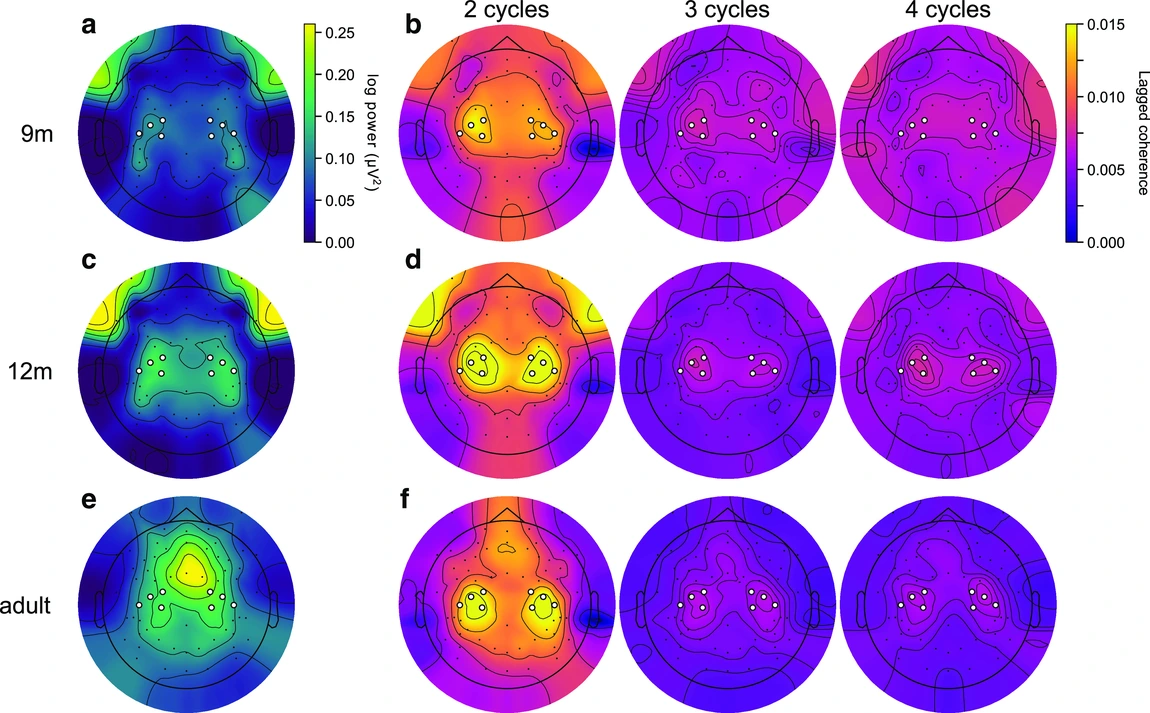
The peak frequency of sensorimotor beta changes with age. Our developmental EEG tutorial describes how to identify brief bursts in infant recordings. We also use lagged Hilbert autocoherence to measure how long a signal stays rhythmic at each frequency.
Funding
The European Research Council supported our work on the development of sensorimotor beta bursts through MOBETA, a Consolidator Grant under the European Union’s Horizon 2020 research and innovation programme (grant agreement 864550). The British Council Springboard Programme supported the Cardiff–Lyon study of beta bursts and motor skill in childhood (award 525715).